


Why’s That Question Asker Steve Merring and I are at Pere Marquette Park in Muskegon on the Lake Michigan beach.
“How would you describe this day, Steve?" I asked.
"Oh, this is a typical March day, even though it's May, and it's blustery, wavy,” he said, and we laughed as the northwesterly wind blew sand across the parking lot.
The retired public school teacher had told me earlier that when he was a poll worker during the last presidential election, he saw something that made him curious.
“I was looking at a map of congressional voting districts and I noticed that our second district went all the way out into Lake Michigan and borders right to the Wisconsin border. And I was wondering, why does the congressional district include the lake when there's no people living there?”
Steve’s from Hastings. His representative is 2nd District Republican John Moolenaar. On the phone from the U.S. Capitol Building, Moolenaar said, it’s true.
“Officially, my district does extend into Lake Michigan to the maritime border with Wisconsin.”
And it’s not just the 2nd District. Up and down the lakeshore, nine out of Michigan’s 13 Congressional Districts include parts of at least one Great Lake. And a tenth district, incidentally named District 10, includes Lake St. Clair, a crucial part of the interconnected Great Lakes ecosystem.
That’s because districts end at the state line. And most of Michigan’s borders are in lakes.

“We don't have islands in my district, but we certainly advocate for projects within the Great Lakes and so that's really the purpose of it,” said Moolenaar.
A Sixth Great Lake?
Fred Upton represented part of West Michigan — and part of Lake Michigan — for 36 years, from 1987 to 2023.
Upton said one of his first Congressional acts was to get an oil spill response team for the Great Lakes.
Growing up in St. Joseph on Lake Michigan gave him firsthand experience, as he told Steve and I in an interview at the station.
“When I went to my uncle's house and we went to the beach, they had a bottle of Mr. Clean on their kitchen step because that would take the oil, the tar, off your feet because you got it every time you went to the beach,” Upton said.
Years later, Upton would go to bat over the very definition of “Great Lake.”
In 1998, Congress renewed funding for Great Lakes coastal research. Buried in the bill was language written by Vermont Senator Patrick Leahy to make Lake Champlain the sixth Great Lake.
“I was incensed,” Upton said.
Lake Champlain is nestled between Vermont, New York and Quebec. By surface area, it’s about 17 times smaller than the smallest Great Lake, Ontario.
Leahy wanted research money for a large lake with similar problems with invasive species and other issues the Great Lakes face.
"You could see where his tentacles were going," Upton said, "and he was a senior player for sure in the Senate."
A senior player who would eventually become president pro tempore of the Senate and third in line to the presidency.
But that didn't stop Upton from introducing a bill to reverse Lake Champlain’s new status.
“We jerked his chain. We embarrassed Leahy. We got some statewide media on this and all of a sudden it was like, felt like, you know ‘little boy that could’ but we got it done,” Upton said.
Lake Champlain’s Great Lakes designation lasted just 18 days. The fab five was back - Huron, Ontario, Michigan, Erie and Superior. "HOMES," the school memory trick intact.
But Leahy didn't go away empty-handed. The stunt brought research dollars to Vermont’s lakes.

Members of Congress and the Canadian Parliament work together to regulate the Great Lakes. In 1955, they created and continue to fund the Great Lakes Fishery Commission.
Victories and future fights
That’s where Greg McClinchey works. Steve and I met up with him back at Pere Marquette Park beach in Muskegon.
“It's an incredibly useful thing that members of Congress or state representatives or members of Parliament on the other side of the border, have that direct, constituency we call it in Canada — district in the United States — link to the water, because it means they're always thinking about it," McClinchey said.
After years of work, lake trout has been restored to Lake Superior and the Uptons don’t wash their feet with Mr. Clean after a day at the beach.
Near Pere Marquette Park, on the Muskegon River, the Commission coordinates lampricide application. Without it, McClinchey said, invasive predator sea lampreys could eliminate fish in the Great Lakes within five years, effectively killing a $5 billion industry.

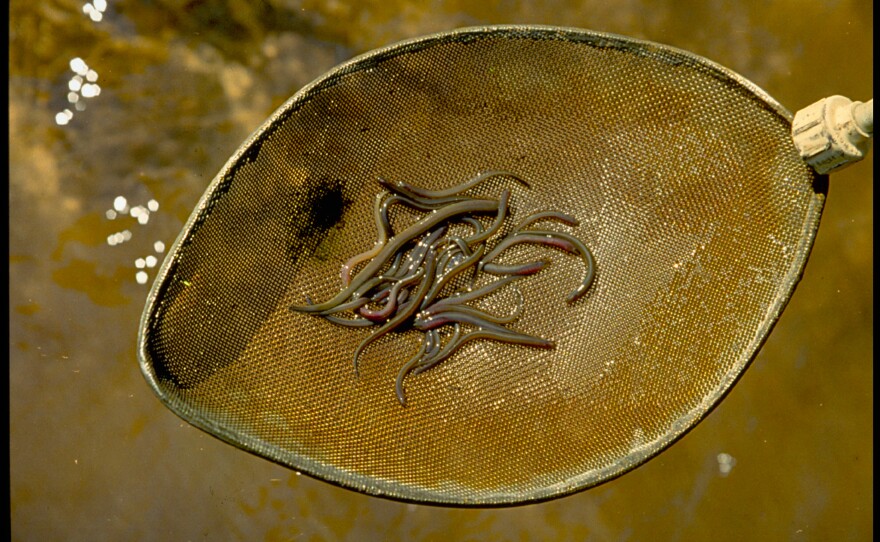
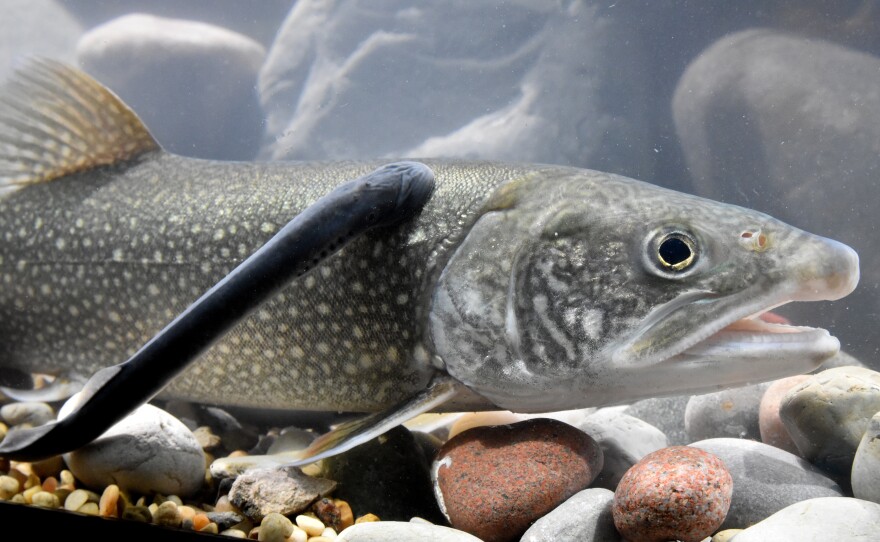
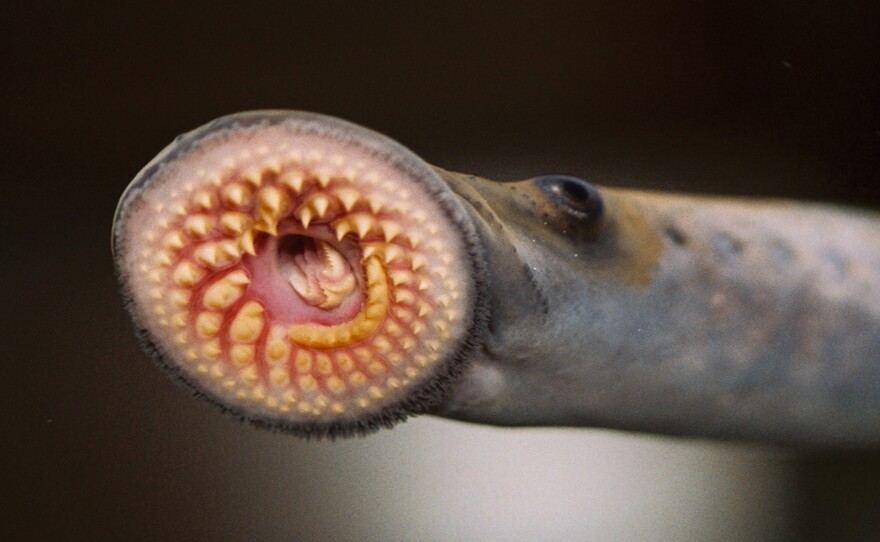
Today, the sound of shoes on crushed invasive zebra and quagga mussel shells that have washed up on the beach can still be heard despite the wind.
"I don't like to give the bad news, but Lake Michigan is probably the lake most afflicted by zebra and quagga mussels — dreissenid muscles, invasive mussels," McClinchey said.
"We don't technically have a mandate to deal with them yet."
But McClinchey said a new bill introduced by Debbie Dingell (D-6th District) and Tim Wahlberg (R-5th District ) could change that.
McClinchey summed it up.
“I think if we didn't have districts that went into the water, we wouldn't have to worry about fish in the water either...'cause there wouldn't be any.”
Did our Why’s That Question Asker, Steve Merring, get his question answered?
“I think so. I am glad to hear that having those boundaries out into the Great Lakes helps give a little bit of buy-in and a sense of responsibility for our representatives in the United States and Canada.”
